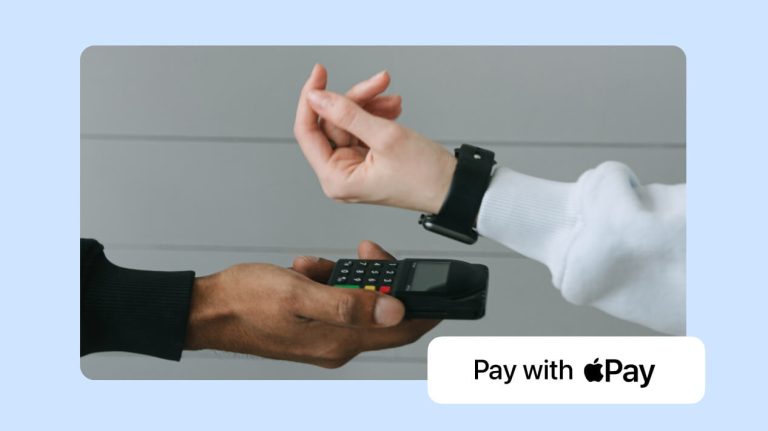
Apple Pay has moved from optional add-on to mainstream expectation. With well over a billion active iPhone users globally and hundreds of millions regularly using Apple Pay, merchants that fail to offer this option risk losing customers at checkout.
In major ecommerce markets such as the United States and the United Kingdom, a significant share of consumers now choose Apple Pay when shopping online. The appeal is straightforward. Payments are fast, biometric authentication feels secure, and there is no need to manually enter card details.
For businesses, that combination translates into higher conversion rates, reduced friction, and improved customer satisfaction.
What Apple Pay Is and How It Works
Apple Pay is a digital wallet built into Apple devices, including iPhone, iPad, Mac, and Apple Watch. It allows users to store debit, credit, and prepaid cards in a secure environment and use them to make payments online, in apps, or in-store via near-field communication technology.
From the merchant perspective, Apple Pay is not a new payment rail. Transactions are processed over existing card networks such as Visa and Mastercard. The difference lies in how credentials are presented and authenticated.
Instead of transmitting a customer’s real card number, Apple Pay uses tokenization. The original card details are replaced with a unique, device-specific token. Each transaction generates a one-time cryptographic value, reducing exposure to fraud.
When customers check out online, they select the Apple Pay button, confirm using Face ID, Touch ID, or a passcode, and the transaction is authorized in seconds.
What Businesses Need to Accept Apple Pay
To offer Apple Pay, merchants must already accept card payments. Apple Pay rides on existing card infrastructure and requires a compatible payment processor or payment service provider.
The processor must support Apple Pay and enable it within the merchant’s account. Once configured, the payment flow mirrors standard card processing, with funds deposited into the merchant’s account after authorization and settlement.
Integration typically involves either a prebuilt checkout solution or direct API implementation.
Why Apple Pay Drives Higher Conversion
Speed matters. In physical stores, tap-to-pay eliminates card insertion and PIN entry. Online, Apple Pay removes the need to manually enter card numbers, expiry dates, billing addresses, and CVV codes.
Customers authenticate with biometrics, and the transaction completes almost instantly.
This reduction in friction reduces cart abandonment. Impatient customers are less likely to leave when checkout feels effortless.
Security also enhances trust. Because sensitive card data is never directly shared with the merchant, and biometric authentication is required, customers feel protected. For merchants, this often means fewer fraud disputes and lower chargeback volumes.
Consumer Preference and Competitive Pressure
Digital wallets have become especially popular among younger consumers, who expect mobile-first payment experiences. In the UK and across Europe, Apple Pay usage continues to grow and increasingly replaces traditional card entry at checkout.
Offering preferred payment methods is directly tied to trust. When customers cannot find their favored option, many abandon the purchase altogether.
In competitive markets, even a small uplift in acceptance or conversion can materially impact revenue.
Liability Shift and Fraud Protection
One of the most valuable features for merchants is liability shift.
When a payment is strongly authenticated, liability for certain fraud-related chargebacks can transfer from the merchant to the card issuer. Apple Pay’s biometric authentication satisfies strong authentication requirements, often eliminating the need for additional 3D Secure challenges while still providing fraud protection benefits.
The result is a smoother checkout for customers and reduced risk exposure for businesses.
Fees and Cost Structure
Apple does not charge merchants additional fees for accepting Apple Pay. Transactions incur standard card processing fees from the payment processor, typically consisting of a percentage of the transaction value plus a fixed amount.
Apple collects a small fee from issuing banks, not from merchants.
From a cost perspective, Apple Pay is treated similarly to any other card transaction, while often delivering better performance metrics.
Implementation Options
Merchants typically integrate Apple Pay in one of two ways.
Prebuilt Checkout Interface
Using a hosted or customizable checkout solution simplifies integration. The payment provider handles display logic, tokenization, and authentication flows. Merchants configure settings and enable Apple Pay within their dashboard. When customers select Apple Pay, the interface manages authentication and returns payment status through webhooks.
Direct API Integration
For greater control, businesses can integrate via API. This requires an Apple Developer account and merchant ID. The front end displays the Apple Pay sheet, collects biometric confirmation, and sends encrypted payment data to the merchant’s server. The server exchanges that data for a single-use token from the payment provider, submits the authorization request, and returns the outcome to the user.
This approach offers deeper customization but requires more development resources.
Expanding Beyond Acceptance
In addition to accepting payments, some providers support Apple Pay for card payouts. This enables merchants to send funds directly to eligible cards linked to Apple Pay, supporting use cases such as refunds, gig economy disbursements, and marketplace settlements.
Optimizing Checkout with Wallets
Integrating Apple Pay should be part of a broader payments strategy that includes intelligent routing, fraud management, and localized payment options.
Merchants should monitor acceptance rates, authorization outcomes, and checkout drop-off points after enabling Apple Pay. In many cases, performance improvements are measurable almost immediately.
Digital wallets are not a passing trend. They represent a structural shift in how consumers expect to pay.