Modern Treasury is positioning itself at the center of the next phase of global money movement by introducing a fully integrated payment service provider designed to combine traditional banking rails with stablecoin infrastructure. The move reflects a broader industry push to simplify how companies build, deploy, and scale financial products without becoming entangled in lengthy bank partnerships or fragmented vendor stacks.
At the heart of the launch is a single API that allows businesses to manage both fiat and digital asset transactions within one unified framework. Instead of stitching together multiple providers for ACH transfers, wires, real-time payments, and stablecoins, companies can access these rails through one orchestration layer. The approach aims to reduce complexity while accelerating product deployment timelines.
According to CEO and co-founder Matt Marcus, unreliable payment infrastructure and drawn-out banking integrations continue to slow innovation. The new platform is designed to remove those bottlenecks, offering what the company describes as a scalable, long-term payments foundation.
A Single Integration for Global Money Movement
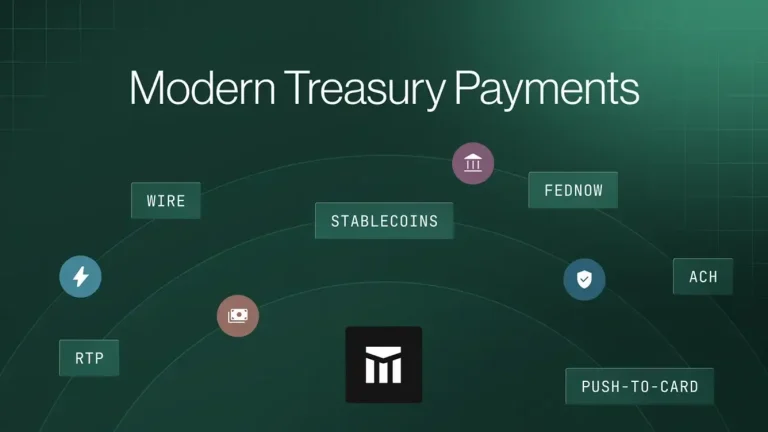
The newly launched service enables businesses to programmatically open payment accounts and initiate transactions across multiple rails. Supported methods include ACH, wire transfers, RTP, FedNow, push-to-card services, and several major stablecoins.
At launch, supported digital assets include USDG, USDP, and USDC, with USDT expected to be added. By embedding stablecoins directly into the same payment stack as traditional rails, the platform treats digital assets as a core component rather than an experimental add-on.
The system runs on the same infrastructure Modern Treasury has used to process more than $400 billion in transactions for major customers such as Gusto, Navan, and Anchorage Digital. This existing orchestration layer includes ledger management, reconciliation tools, and compliance workflows, providing enterprise-grade reliability from day one.
One of the primary advantages is speed to market. Securing bank sponsorships or launching through traditional Banking-as-a-Service models can take six to twelve months. Modern Treasury claims companies can go live in a matter of days using its new PSP.
Reducing Fragmentation in Fiat and Stablecoin Operations
Head of Stablecoins Dan Mottice emphasized that many companies currently rely on multiple vendors to handle fiat payments and stablecoin transactions separately. This fragmented approach requires internal teams to reconcile data across systems, manage separate compliance checks, and maintain distinct integrations.
By consolidating these processes into one API, the company removes the need for businesses to build custom middleware. Stablecoins become a first-class rail within the broader payments ecosystem, operating alongside ACH and real-time bank transfers without additional engineering overhead.
The architecture supports a “scale-forever” model. Startups can begin using the PSP immediately and later transition to direct banking relationships without changing their integration. This continuity reduces the risk of costly platform migrations as companies grow.
Embedded Compliance and Automated Account Creation
For marketplaces and software platforms, embedding payments directly into user experiences has become essential. Modern Treasury’s service addresses this demand by incorporating automated compliance capabilities, including Know Your Customer and Know Your Business checks.
Businesses can programmatically create accounts for end users, each tied to a dedicated ledger. This enables real-time balance tracking, transaction histories, and reconciliation reporting. By automating compliance and ledger infrastructure, product teams can focus on customer-facing features rather than regulatory administration.
The platform’s compliance tooling is designed to support enterprise clients while maintaining the flexibility startups need to iterate quickly. This dual capability reflects growing demand for financial infrastructure that scales without sacrificing governance standards.
Stablecoins as a Core Payment Rail
A significant portion of the initiative builds on Modern Treasury’s earlier acquisition of Beam, which focused on digital asset infrastructure. By fully integrating Beam into its core systems, the company now treats stablecoins as a foundational payment rail rather than a supplementary feature.
To strengthen its ecosystem, Modern Treasury has partnered with several major infrastructure providers. It works with Paxos to integrate regulated digital dollar assets and participates in the Global Dollar Network. The company is also a certified member of the Circle Alliance Program, enabling streamlined USD conversion and near-instant cross-border settlement.
This integrated structure allows businesses to move funds internationally using stablecoins while maintaining regulatory alignment and operational transparency. For cross-border use cases, settlement can occur in minutes rather than days, reducing working capital constraints.
Early adopters, including fintech platforms such as Sling Money, are leveraging the system to unify domestic and international payments without relying on multiple back-end providers.
Toward a Unified Financial Infrastructure Layer
The broader goal is to eliminate the divide between traditional finance and blockchain-based settlement systems. By abstracting both rails behind a single API, Modern Treasury aims to create a payments environment where companies do not need to distinguish between fiat and digital infrastructure.
Instead of navigating separate workflows for bank transfers and stablecoin settlements, businesses interact with one unified orchestration layer. The system automatically routes payments across the appropriate rail while maintaining compliance, reconciliation, and reporting standards.
As stablecoin adoption accelerates and real-time bank networks expand, the integration of both into a cohesive framework signals a shift toward programmable, interoperable financial infrastructure designed for global scale.